If you’ve made it to the point where you’re ready to test for SIBO, you’ve probably already spent months dealing with unexplained bloating, digestive unpredictability, and the exhausting process of trying to figure out what’s wrong. Getting to the testing stage feels like progress—finally, a concrete step toward answers.
But then you encounter a new question: should you take a lactulose or glucose SIBO test? Maybe your practitioner mentioned both options without clearly explaining the difference. Perhaps you’re ordering an at-home test and need to choose between the two substrates. You might have read conflicting information online about which one is “better” or more accurate.
The lactulose vs glucose test debate can feel like just another layer of confusion when you’re already overwhelmed. The truth is, neither test is universally superior. Each has distinct advantages and limitations, and the “right” choice often depends on your individual situation, your practitioner’s preference, and what specific information you’re trying to gather.
This article will walk you through the key differences between these two testing substrates so you can have informed conversations with your healthcare provider about which approach might be most appropriate for your case.
Table of Contents
ToggleQuick Refresher: What Is a SIBO Breath Test?
Before diving into the lactulose vs glucose comparison, let’s briefly review how SIBO breath testing works.
A SIBO breath test measures hydrogen and methane gases in your breath after you consume a sugar solution. When bacteria in your small intestine ferment the sugar, they produce these gases as byproducts. The gases are absorbed into your bloodstream, carried to your lungs, and exhaled in your breath.
By measuring gas levels at regular intervals—typically every 15-20 minutes over 2-3 hours—the test can help identify patterns that may suggest bacterial overgrowth in the small intestine. The timing and degree of gas elevation provide clues about where overgrowth might be located and which types of organisms may be involved.
The main difference between testing options comes down to which sugar substrate you consume: lactulose or glucose. Both serve the same basic purpose—providing fuel for bacteria to ferment—but they behave differently in your digestive system.
For a comprehensive understanding of how breath testing works, accuracy considerations, and what to expect during the process, our SIBO breath test guide provides detailed context that complements this substrate comparison.
What Is the Lactulose Test?
The lactulose SIBO breath test uses lactulose, a synthetic disaccharide sugar that the human body cannot digest or absorb. This means lactulose travels through your entire small intestine without being absorbed, eventually reaching your colon.
How Lactulose Works
Because lactulose isn’t absorbed, it can potentially detect bacterial overgrowth anywhere along the length of the small intestine—from the proximal (upper) sections all the way to the distal (lower) sections near where the small intestine meets the colon.
You drink a lactulose solution, then provide breath samples every 15-20 minutes for approximately 3 hours. If bacteria are present in your small intestine, they’ll ferment the lactulose and produce hydrogen and/or methane gas that shows up in your breath samples.
Advantages of Lactulose Testing
The primary advantage of lactulose is its ability to assess the entire small intestine:
- Broader detection range: Can identify overgrowth in the distal (lower) portions of the small intestine that glucose might miss
- Widely studied: Lactulose has been used in SIBO research for decades and is well-established in clinical practice
- Comprehensive assessment: May provide more complete information about bacterial distribution throughout the small intestine
Many practitioners prefer lactulose because it doesn’t get absorbed early, giving a more complete picture of what’s happening throughout the entire small intestine.
Limitations and Considerations
Lactulose testing isn’t without challenges:
Potential for false positives: Because lactulose eventually reaches the colon where normal bacteria live, gas production late in the test (typically after 90-120 minutes) might be from normal colonic fermentation rather than small intestinal overgrowth. This makes timing interpretation critical.
Longer test duration: Lactulose tests typically run for 3 hours instead of 2, which can be uncomfortable if you’re experiencing symptoms during testing.
Transit time variability: If your gut transit is particularly fast, lactulose might reach the colon sooner than expected, potentially creating ambiguous results. If transit is very slow, it might take longer to produce measurable gas.
Interpretation complexity: The timing of gas rises matters significantly with lactulose. An early rise (within the first 90 minutes) generally suggests SIBO, while later rises might indicate normal colonic fermentation or rapid transit.
What Is the Glucose Test?
The glucose SIBO breath test uses glucose, a simple sugar (monosaccharide) that is normally absorbed in the first portion of the small intestine. Unlike lactulose, glucose doesn’t typically make it to the colon in significant amounts.
How Glucose Works
When you drink a glucose solution, it’s absorbed relatively quickly in the proximal small intestine under normal circumstances. If bacteria are overgrown in this area, they’ll ferment the glucose before it can be absorbed, producing detectable gases.
Glucose tests typically run for 2 hours rather than 3, with breath samples collected every 15-20 minutes.
Advantages of Glucose Testing
The glucose test offers several potential benefits:
- Higher specificity: Because glucose is absorbed early and doesn’t reach the colon, any fermentation detected is more likely to be from small intestinal bacteria rather than normal colonic bacteria
- Fewer false positives: The risk of mistaking normal colonic fermentation for SIBO is reduced
- Shorter duration: A 2-hour test is more comfortable than a 3-hour test, especially if you’re symptomatic
- Clearer interpretation: Without the confounding factor of colonic fermentation, results may be more straightforward to interpret
Some practitioners prefer glucose for its specificity—when it’s positive, you can be more confident the signal is coming from the small intestine.
Limitations and Considerations
Glucose testing also has drawbacks:
May miss distal SIBO: Because glucose is absorbed in the first portion of the small intestine, it might not detect bacterial overgrowth in the lower (distal) sections. If your overgrowth is concentrated in the latter part of the small intestine, glucose testing could produce a false negative.
Potentially lower sensitivity: The trade-off for higher specificity is potentially missing some cases of SIBO that lactulose would detect.
Less comprehensive view: You’re getting information about the proximal small intestine but not the entire length.
Lactulose vs Glucose Test: Key Differences
Understanding the practical differences between these two substrates can help clarify which might be more appropriate for your situation.
Substrate Travel Distance
Lactulose: Travels through the entire small intestine and into the colon
Glucose: Absorbed in the first portion of the small intestine
This fundamental difference affects what each test can detect.
Detection Range
Lactulose: Can detect overgrowth anywhere in the small intestine, including distal sections
Glucose: Primarily detects overgrowth in the proximal (upper) small intestine
Sensitivity vs. Specificity
Lactulose: Higher sensitivity (better at detecting SIBO when present) but potentially lower specificity (more false positives from colonic fermentation)
Glucose: Higher specificity (fewer false positives) but potentially lower sensitivity (may miss distal overgrowth)
Test Duration
Lactulose: Typically 3 hours
Glucose: Typically 2 hours
Interpretation Complexity
Lactulose: Timing of gas rise is critical; early rise suggests SIBO, late rise may be colonic fermentation
Glucose: Generally more straightforward interpretation since glucose doesn’t reach the colon
Potential for False Results
Lactulose: Risk of false positives from colonic fermentation; risk of false negatives if transit is very slow
Glucose: Risk of false negatives if overgrowth is in distal small intestine; fewer false positives
Clinical Use
Lactulose: Widely used in research studies and clinical practice; considered the standard by many practitioners
Glucose: Preferred by some practitioners for its specificity; gaining popularity in certain clinical settings

Which Test Is More Accurate?
This is the question everyone wants a definitive answer to, but the truth is more nuanced than “lactulose is better” or “glucose is better.”
Accuracy Depends on Multiple Factors
Test accuracy isn’t just about the substrate—it’s about:
- Your specific pattern of overgrowth: Where bacteria are located in your small intestine
- Your gut transit time: How quickly food moves through your system
- Interpretation expertise: How skilled your practitioner is at reading results in context
- Symptom correlation: Whether test results align with your clinical presentation
- Testing conditions: How well you followed preparation protocols
The Gold Standard Context
Technically, the gold standard for diagnosing SIBO is small bowel aspiration and culture—collecting fluid directly from the small intestine during an endoscopy and measuring bacterial counts. But this is invasive, expensive, and rarely performed.
Breath testing emerged as a practical alternative, and both lactulose and glucose are considered acceptable options. Research comparing the two shows variable results, with some studies suggesting lactulose has better sensitivity while glucose has better specificity.
What Research Suggests
Studies examining breath test accuracy show:
- Neither substrate is perfect
- Sensitivity and specificity vary depending on cutoff values used for positive results
- Both tests have false negative and false positive rates
- Clinical correlation with symptoms often matters more than test numbers alone
The Interpretation Factor
Perhaps more important than which substrate you use is who’s interpreting your results. An experienced practitioner who understands the nuances of both tests, considers your symptoms and medical history, and knows how to correlate clinical presentation with breath test data will provide more value than choosing the “perfect” substrate with poor interpretation.
Does Test Type Affect Treatment?
Here’s an important consideration: in most cases, the substrate you use for testing doesn’t significantly change your treatment approach.
Treatment Targets Gas Type, Not Substrate
What matters more for treatment planning is which gases are elevated—hydrogen, methane, or both—rather than whether you used lactulose or glucose to detect them.
If your test shows elevated hydrogen, you likely have hydrogen-producing bacteria overgrown in your small intestine. If methane is elevated, you have methane-producing archaea (methanogens). If both are elevated, you have a mixed presentation.
Treatment protocols typically target these different gas types with specific antimicrobial approaches, whether pharmaceutical or herbal. The substrate used to identify the overgrowth becomes less relevant once you know which organisms you’re dealing with.
Root Cause Matters Most
Beyond treating the overgrowth itself, identifying and addressing root causes—like impaired motility, low stomach acid, structural issues, or post-infectious damage—matters far more than which breath test substrate revealed your SIBO in the first place.
Hydrogen vs. Methane Significance
Understanding whether you have hydrogen-dominant, methane-dominant, or mixed SIBO helps explain your symptom pattern and guides treatment choices. Hydrogen is often associated with diarrhea-predominant presentations, while methane typically correlates with constipation.
For a deeper exploration of how these different gas types affect symptoms and treatment, understanding the distinction between hydrogen and methane SIBO provides valuable context that complements test substrate considerations.
When to Discuss Testing With a Practitioner
Choosing between lactulose and glucose testing isn’t a decision you need to make alone. In fact, involving a knowledgeable healthcare provider significantly improves the value you’ll get from testing.
Who Can Help
Several types of practitioners work with SIBO breath testing:
- Gastroenterologists
- Functional medicine doctors
- Naturopathic physicians
- Integrative medicine specialists
Questions to Ask Your Practitioner
When discussing testing options, consider asking:
- Which substrate do you typically use, and why?
- Based on my symptoms and history, which test might provide better information?
- How will you interpret results in the context of my clinical presentation?
- What happens if the test is negative but symptoms persist?
- Will we consider retesting after treatment?
Personalized Decision-Making
Your practitioner might recommend lactulose if:
- They want a comprehensive assessment of your entire small intestine
- You have a history suggesting possible distal SIBO
- They’re following research protocols that used lactulose
They might recommend glucose if:
- They want higher specificity with fewer false positives
- You have very rapid transit that might confound lactulose interpretation
- They’re more comfortable interpreting glucose results
At-Home Testing Considerations
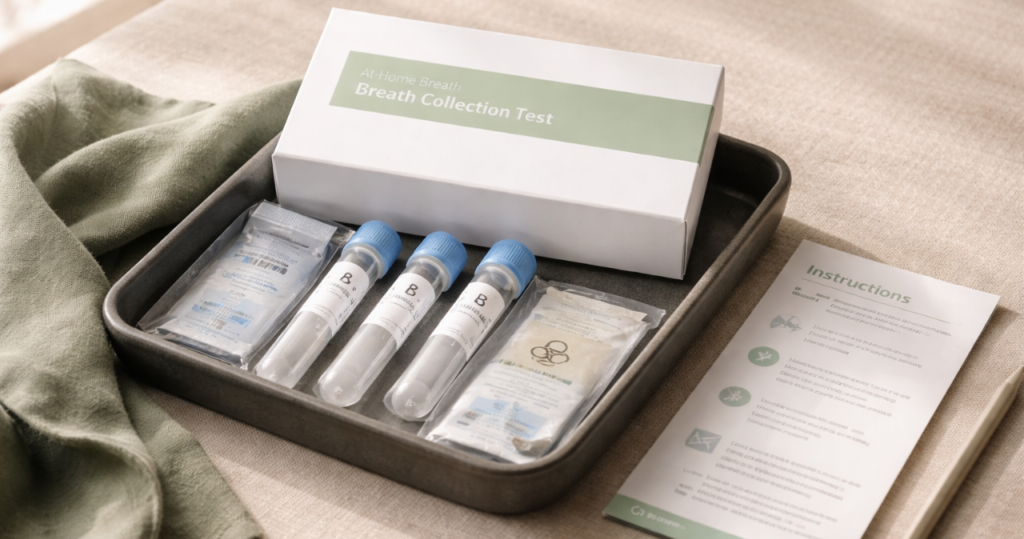
If you’re using an at-home SIBO test kit, you’ll likely need to choose the substrate yourself. In this case:
- Research the testing company’s recommendations
- Consider which limitation you’re more comfortable with (potentially missing distal overgrowth vs. potentially getting false positives from colonic fermentation)
- Plan to review results with a knowledgeable practitioner regardless of which substrate you choose
Professional interpretation remains important even with at-home testing.
Understanding Your Testing Options
The lactulose vs glucose test decision doesn’t have a universal right answer. Both substrates are commonly utilized in clinical settings, and both have supported countless people in identifying and addressing SIBO.
Lactulose may provide broader insight into bacterial distribution throughout the small intestine but requires careful interpretation to distinguish small intestinal overgrowth from normal colonic fermentation. Glucose offers higher specificity but might miss overgrowth in the lower portions of the small intestine.
What matters most isn’t which substrate you choose—it’s that you:
- Work with a practitioner who understands SIBO breath testing
- Follow proper preparation protocols
- Interpret results in the context of your symptoms and medical history
- Use testing as one tool within a comprehensive approach to gut healing
- Don’t let test results alone define your treatment path
For comprehensive information about SIBO breath testing beyond substrate choice—including preparation guidelines, accuracy considerations, and what to do with results—our SIBO breath test guide provides detailed context for each phase of the testing process.
If you prefer visual learning formats, we share structured breakdowns of testing protocols, symptom correlations, and gut health education on Pinterest to complement the written guides here.
Testing is just one step in your healing journey. Whether you choose lactulose or glucose, the goal remains the same: gathering information that helps you and your healthcare team make informed decisions about addressing your gut health.
Disclaimer: We are not licensed medical professionals. The information shared here reflects personal healing experience and educational research. Always consult a qualified healthcare provider before making medical decisions.